
Key takeaways
- Most job seekers revise their resume 3+ times before landing interviews, yet the majority never get expert eyes on it—free feedback tools fill this gap without the cost of professional services.
- 75% of resumes are rejected by Applicant Tracking Systems before reaching human recruiters, making AI scanners your essential first checkpoint.
- The strategic sequence matters: AI tools catch formatting and keyword gaps instantly, while human reviewers on Reddit or peer networks identify tone, relevance, and story issues AI misses.
- Effective feedback loops combine 2-3 tools in sequence—scan with AI first, revise, then submit for human review—rather than relying on a single source.
- Reddit's r/resumes community has over 385,000 members providing peer resume reviews, typically delivering feedback within 6-24 hours.
Most articles about getting resume feedback online free simply list every available tool. That's not helpful when you're staring at a blank application deadline. You need to know which tool to use first. You need to know which one catches what AI misses. You need to know how long each step actually takes. I've watched too many job seekers waste days bouncing between platforms without a clear workflow. Some rely solely on an AI scanner that flags keywords but completely ignores whether their accomplishments sound credible to a human hiring manager.
The truth is that no single free tool gives you complete feedback. AI-powered scanners excel at catching ATS compatibility issues and keyword gaps in seconds. Human reviewers spot messaging problems, tone mismatches, and relevance issues that algorithms can't parse. These reviewers include people on Reddit, professional networks, or alumni groups. The gap in every guide I've read is the sequencing: which tool when, how to integrate feedback across platforms, and realistic timelines for each stage.
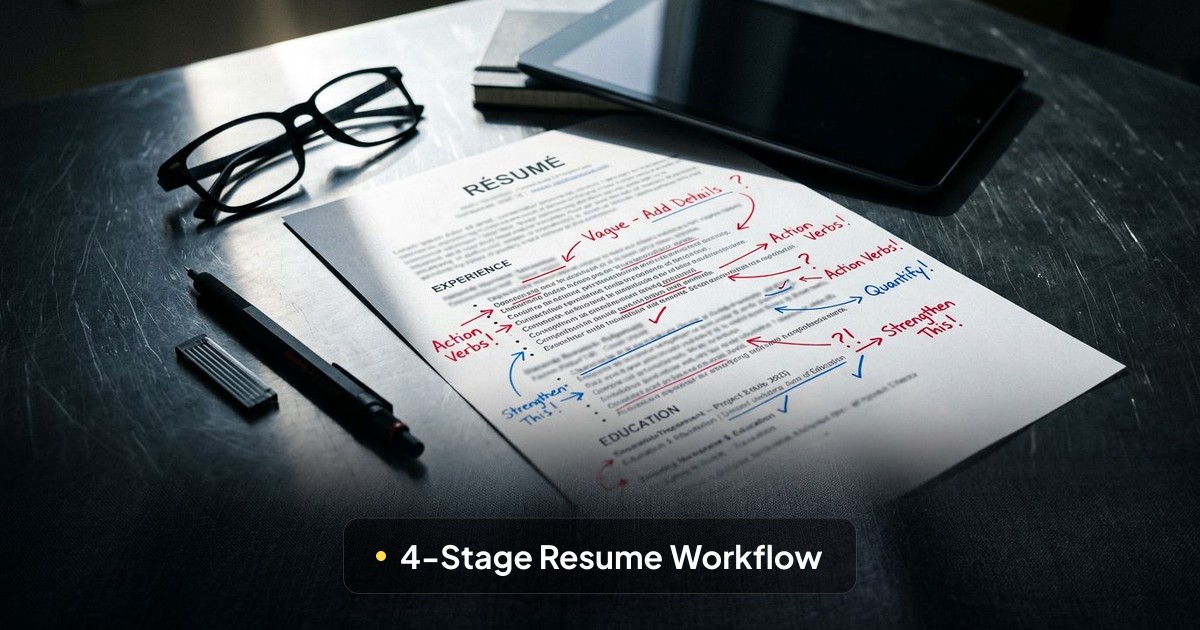
This guide walks you through a proven four-stage workflow. The stages are: scan, revise, human review, final polish. I'll show you specific free tools for each step. I'll give you honest trade-offs on speed, depth, anonymity, and account requirements.
Why you need multiple feedback sources (and why most job seekers skip this step)
Here's the uncomfortable reality: the average recruiter spends 6-7 seconds reviewing a resume during initial screening. If your resume has ATS formatting errors, it never reaches that 6-second scan. If it passes ATS but your bullet points read like a job description instead of achievements, those 6 seconds end with a rejection.
Single-source feedback creates blind spots. An AI resume checker free tool will flag missing keywords and parse errors. But it won't tell you that your "led cross-functional initiatives" bullet is vague corporate jargon. A peer resume review on Reddit will catch that your summary sounds generic. But it might miss that your two-column layout will confuse most ATS parsers.
Job seekers skip comprehensive feedback for three reasons. They don't know the workflow exists. They assume one tool is enough. Or they're rushing to hit application deadlines. The result is resumes that either fail ATS silently or pass the scanner but bore human readers. Both outcomes waste your time.
Recommendation: Treat resume feedback as a multi-stage quality check, not a single event. Budget 24-48 hours for the full cycle if you want both technical optimization and human-validated messaging. If you're applying to a role today, prioritize the AI scan. It's instant and catches the most common rejection triggers.
Stage 1: AI scanners for instant ATS and keyword analysis
Start here. AI-powered resume checkers analyze your document against job descriptions in seconds. They flag formatting issues, missing keywords, and ATS compatibility problems. Do this before you waste time on human feedback for a resume that won't parse correctly.
Jobscan (free tier): Upload your resume and paste the target job description. Jobscan's free version gives you a match score. It highlights missing keywords. It flags common ATS errors like tables, text boxes, or headers that confuse parsers. The free tier limits you to a handful of scans per month, but it's enough to test your core resume template. Trade-off: detailed section-by-section feedback requires a paid plan.
Resume Worded: This tool offers instant scoring on impact, brevity, and keyword optimization. The free version includes line-by-line suggestions. It flags weak action verbs or vague phrases. It's particularly strong on identifying bullet points that describe responsibilities instead of achievements. Trade-off: some advanced features (like LinkedIn profile optimization) sit behind a paywall. The tool occasionally suggests keyword stuffing that reads awkwardly to humans.
RankResume's AI-powered resume builder: If you're starting from scratch or converting an existing resume into an ATS-compliant format, RankResume's free AI resume builder analyzes your text and job description. It then outputs a professionally formatted LaTeX resume and cover letter in 60 seconds. The platform handles keyword optimization and ATS compatibility automatically. It includes a match score breakdown showing exactly where your resume aligns with the job posting. You get 1 free credit on signup—no credit card required. Trade-off: it's a builder, not just a feedback tool. You'll get a new formatted document rather than annotations on your existing file.
What AI catches (and what it misses)
AI scanners excel at technical issues. Heavy graphics confuse ATS systems, and clean structure wins more interviews than fancy layouts. They flag missing keywords when a job description emphasizes "Salesforce CRM" and your resume says "customer database." They catch formatting errors like columns, tables, or text boxes that cause parsing failures.
AI misses context. It can't tell you whether your "increased sales by 40%" claim sounds plausible for your role level. It can't tell you whether your summary reads like every other mid-level project manager. It won't flag that you've listed "Microsoft Office" as a skill when applying for a senior data engineering role. That's technically accurate, but it signals you don't understand what's relevant.
Recommendation: Run your resume through at least one AI scanner before seeking human feedback. Fix the technical issues first. There's no point asking a human reviewer to critique messaging on a resume that won't survive ATS parsing. Expect instant results. Most AI tools return feedback in under 60 seconds.
Stage 2: Revise based on AI feedback (the step most people skip)
You've received your AI scan results. Now comes the critical step that separates effective feedback loops from wasted effort. You need to actually implement the changes before moving to human review.
AI tools often generate 15-30 suggestions. Prioritize them in this order:
- ATS compatibility errors (tables, columns, graphics, headers/footers)—these cause instant rejection
- Missing critical keywords from the job description that match your actual experience
- Weak action verbs or responsibility-focused bullets that should highlight achievements
- Formatting inconsistencies (font sizes, bullet styles, spacing)
Don't implement every suggestion blindly. If an AI tool recommends adding "synergized cross-functional stakeholders" to hit a keyword, ignore it. That phrasing will fail human review. If it flags a missing keyword you genuinely don't have experience with, don't fabricate it.
This revision pass typically takes 30-90 minutes. The time depends on how many issues the scan surfaced. Save your revised version as a new file before proceeding to human review. You'll want to compare feedback across versions.
Recommendation: Focus on the top 10 highest-impact changes first. If you're short on time, fix ATS errors and add missing keywords that reflect real experience. Skip the minor formatting tweaks until after human review confirms your messaging works.
Stage 3: Human review for tone, relevance, and credibility
AI has optimized your resume for machines. Now you need human eyes to confirm it resonates with actual hiring managers. This stage catches messaging problems, relevance mismatches, and credibility issues that algorithms can't evaluate.
Reddit r/resumes: Peer feedback from 385,000+ members
Reddit's r/resumes community is the largest free peer resume review platform. Post your resume (redact personal details). Include your target role and industry. Expect feedback within 6-24 hours. The community skews toward early-career and mid-level job seekers. You'll get perspective from people recently navigating the same market.
What works well: Reviewers catch vague bullets, generic summaries, and accomplishments that don't match your claimed seniority level. They'll tell you if your "led a team" claim needs numbers. They'll tell you if your summary sounds like it was generated by ChatGPT without editing. The feedback is blunt and actionable.
Trade-offs: Quality varies by who responds. Some reviewers offer detailed line-by-line critiques. Others drop a quick "looks good" without substance. You're also posting publicly, so even with redactions, there's less privacy than other options. Expect 6-24 hour turnaround, longer on weekends.
How to get better feedback: Be specific in your post title and context. "Marketing Manager resume, 5 YOE, targeting SaaS companies" gets better responses than "Please review my resume." Mention what you've already optimized. For example: "Already ran through Jobscan, looking for human perspective on messaging."
LinkedIn Career Advice: Professional network feedback
LinkedIn's Career Advice feature connects you with professionals in your target industry. These people have volunteered to provide guidance. Request a resume review through the platform. You'll typically get feedback from someone 5-10 years ahead in your career path.
What works well: Reviewers bring industry-specific context. A marketing professional will catch that "growth hacking" is dated terminology in 2026. They'll notice that your B2B SaaS experience should emphasize ARR and pipeline metrics rather than generic "sales growth." The feedback often includes networking opportunities. Reviewers sometimes offer to make introductions.
Trade-offs: Response time is unpredictable (2-7 days). Some volunteers provide only surface-level feedback. You need an active LinkedIn profile to access the feature. The review happens via LinkedIn messaging, which is less structured than dedicated resume platforms.
Recommendation: Use LinkedIn Career Advice when you need industry-specific validation. This is especially helpful for career changes or senior roles where context matters more than ATS optimization. Pair it with Reddit for a faster, broader perspective.
University alumni networks and career services
If you're a recent graduate or within 5-10 years of graduation, your university likely offers free resume reviews to alumni. Many career centers provide virtual appointments with counselors who specialize in specific industries.
What works well: Career counselors see hundreds of resumes per semester. They can quickly spot common mistakes. They often have relationships with employers in your target industry. They know what those companies prioritize. The feedback is private and typically includes a 30-45 minute video call to discuss changes.
Trade-offs: Availability is limited, especially during peak recruiting seasons (September-November, January-March). Some career centers restrict services to recent graduates only. Turnaround time for appointments can be 1-2 weeks.
Recommendation: Book an alumni career services appointment as soon as you start your job search. Do this even before you need urgent feedback. Use it as your "final polish" review after you've completed AI scanning and peer feedback. Career counselors are most valuable when you bring them a nearly finished resume that needs expert validation, not a rough draft.
The strategic feedback sequence that actually works
Here's the workflow I recommend based on realistic timelines and tool strengths:
| Stage | Tool | What it catches | Turnaround | Account required? |
|---|---|---|---|---|
| 1. Initial scan | Jobscan or Resume Worded | ATS errors, missing keywords, formatting issues | Instant | Yes (free tier) |
| 2. Revise | Manual editing | Implement AI feedback | 30-90 min | No |
| 3. Human review | Reddit r/resumes | Vague bullets, tone issues, credibility gaps | 6-24 hours | Yes (Reddit account) |
| 4. Industry validation | LinkedIn Career Advice | Industry-specific terminology, relevance | 2-7 days | Yes (LinkedIn profile) |
| 5. Final polish | Alumni career services | Expert validation, interview prep | 1-2 weeks | Varies by institution |
If you have 48 hours before an application deadline: Complete stages 1-3 only. Skip LinkedIn and alumni services. They're too slow for urgent applications. An AI-scanned, peer-reviewed resume is exponentially better than an unreviewed one.
If you're planning a longer job search: Complete all five stages for your core resume template. Then use stages 1-2 only for each tailored application. Your messaging and tone are validated. You're just optimizing keywords per job.
If you're applying to 10+ roles per week: Use RankResume's AI resume builder to handle stages 1-2 automatically for each application. Then submit your core template for human review once to validate your overall approach. Tailoring for every job manually isn't realistic at high volume.
What to do when feedback conflicts
You'll receive contradictory advice. One Reddit reviewer will say your summary is too long. Another will praise it. An AI tool will recommend adding a keyword. A human reviewer will say it sounds forced.
Prioritize based on the failure mode: ATS compatibility issues (from AI) trump human style preferences. A resume that doesn't parse never reaches human review. Among human feedback, prioritize comments from people in your target industry over general advice.
Look for consensus: If three reviewers independently flag the same bullet point as vague, they're right. This is true even if one reviewer thought it was fine. If only one person suggests a change and others don't mention that section, it's likely a style preference rather than a critical flaw.
Test when possible: If you're applying to multiple similar roles, A/B test conflicting advice. Use version A for half your applications. Use version B for the other half. Track which generates more responses. This only works if you're applying at volume and the roles are comparable.
Recommendation: Create a feedback log. Use a simple document where you list each suggestion, the source, and whether you implemented it. This prevents you from second-guessing decisions or losing track of what you've already tested.
Free tools worth skipping (and why)
Not every free resume review service delivers value. Here are the ones I don't recommend:
Generic "resume grader" websites with no clear methodology: Many sites offer a "free resume score" that's really a lead-generation funnel for paid services. They provide a vague score (68/100!) with no actionable feedback unless you upgrade. If a tool doesn't explain its scoring criteria or show you specific issues in the free tier, skip it.
Facebook job search groups: Some niche industry groups offer helpful feedback. But general job search Facebook groups tend to attract spam, outdated advice, and reviewers who haven't hired anyone in years. The signal-to-noise ratio is poor compared to Reddit or LinkedIn.
"AI resume builders" that just fill templates: Some tools market themselves as AI-powered. But they simply drop your text into a template without any optimization or feedback. If a tool doesn't show you a match score, flag specific issues, or explain what it's improving, it's not providing feedback. It's reformatting.
Recommendation: If a free tool asks for your email before showing you any sample feedback or explaining its methodology, assume it's lead generation rather than a genuine feedback tool. Legitimate services show you what you'll get before requiring account creation.
How to combine free feedback with paid tools (if you have budget)
Free tools provide 80-90% of the value of paid services for most job seekers. But if you're in a specialized field, targeting executive roles, or struggling after 50+ applications with no callbacks, paid options can fill specific gaps.
Use free tools for ATS optimization and general feedback first. If you're still not getting traction, consider paid services for:
- Executive resume writing (director level and above): Free tools and peer reviewers lack context for senior roles where accomplishments need board-level framing
- Career change narratives: Translating skills across industries requires expertise that generalist AI and peer reviewers often miss
- Technical roles with niche requirements: If you're a data scientist, cybersecurity engineer, or other specialist, industry-specific resume writers understand what hiring managers prioritize
Don't pay for services that promise to "beat the ATS" with secret formatting. That's what free AI scanners already do. Don't pay for generic resume templates. Free tools like RankResume provide professional LaTeX formatting at no cost.
Recommendation: Exhaust free feedback options first. If you're getting interviews but not offers, the issue is probably interview skills, not your resume. If you're getting zero callbacks after 30+ tailored applications with verified ATS optimization, then consider paid professional review.
The biggest mistake job seekers make with free feedback tools
The most common failure mode isn't using the wrong tool. It's treating feedback as a one-time event rather than an iterative process.
I've seen job seekers run their resume through Jobscan and get a 75% match score. They assume they're done. They skip human review because "the AI said it's good." Then they apply to 40 jobs and get zero responses. They never realize their bullets read like a job description rather than achievements.
Others do the opposite. They post on Reddit and get conflicting feedback from five reviewers. They implement every suggestion. They end up with a Frankenstein resume that sounds like it was written by committee. They never tested the AI scan, so they don't know their revised version has formatting errors that break ATS parsing.
The fix is simple. Use the four-stage sequence (scan → revise → human review → final polish) for your core resume template. Then treat each job application as a mini-cycle of stages 1-2 only. Your messaging is validated. You're just optimizing for the specific role.
Recommendation: Block out a full weekend to complete the four-stage cycle for your master resume template. Then, for each application, budget 15-20 minutes for AI scanning and keyword optimization. This approach gives you both strategic validation and tactical efficiency.
When to stop seeking feedback and start applying
Perfectionism kills momentum. I've watched job seekers spend six weeks "optimizing" their resume while their target roles get filled. At some point, you need to ship.
Here's when you're ready to apply:
- Your resume passes at least one AI scanner with 70%+ match score for your target role type
- At least two human reviewers (Reddit, LinkedIn, alumni, or mentors) have confirmed your bullets sound credible and relevant
- You've fixed all ATS compatibility errors (no tables, columns, graphics, or parsing issues)
- Your accomplishments include specific outcomes (numbers, percentages, or clear before/after states)
You don't need unanimous praise from every reviewer. You don't need a 95% match score. You don't need perfect phrasing in every bullet.
If you've completed the four-stage sequence and addressed the major feedback themes, further optimization delivers diminishing returns. The next bottleneck is probably application volume, interview skills, or your job search strategy—not your resume.
Recommendation: Set a deadline. Give yourself one weekend for the full feedback cycle. Implement the top-priority changes. Then start applying. You can refine your resume between applications based on response rates. But waiting for perfection before sending your first application guarantees you'll still be "optimizing" when the job market shifts.
Your next steps: The 48-hour feedback sprint
If you're reading this, you probably need to get resume feedback online free and start applying soon. Here's your action plan:
Today (2 hours):
- Run your current resume through Jobscan or Resume Worded against your target job description
- Fix the top 10 ATS and keyword issues flagged by the AI scan
- Post your revised resume to Reddit r/resumes with specific context about your target role
Tomorrow (1 hour):
- Review Reddit feedback (should arrive within 24 hours)
- Implement the consensus recommendations (anything 2+ reviewers mentioned)
- Request a LinkedIn Career Advice connection for industry-specific validation
Day 3 (30 minutes):
- Run your revised resume through the AI scanner again to confirm you didn't break anything
- Save your optimized resume as your new master template
- Start applying to roles while LinkedIn feedback arrives
This 48-hour sprint gives you both machine and human validation without analysis paralysis. You'll have a resume that passes ATS screening and resonates with human reviewers. These are the two essential filters between you and interviews.
For ongoing applications, use RankResume's AI-powered resume builder to tailor your validated master template to each job description in 60 seconds. You've already confirmed your messaging works through human review. Now you're just optimizing keywords per role.
The job search is a volume game where quality still matters. Free feedback tools give you the quality foundation. Now you need to apply that foundation at scale.
Leave a comment